
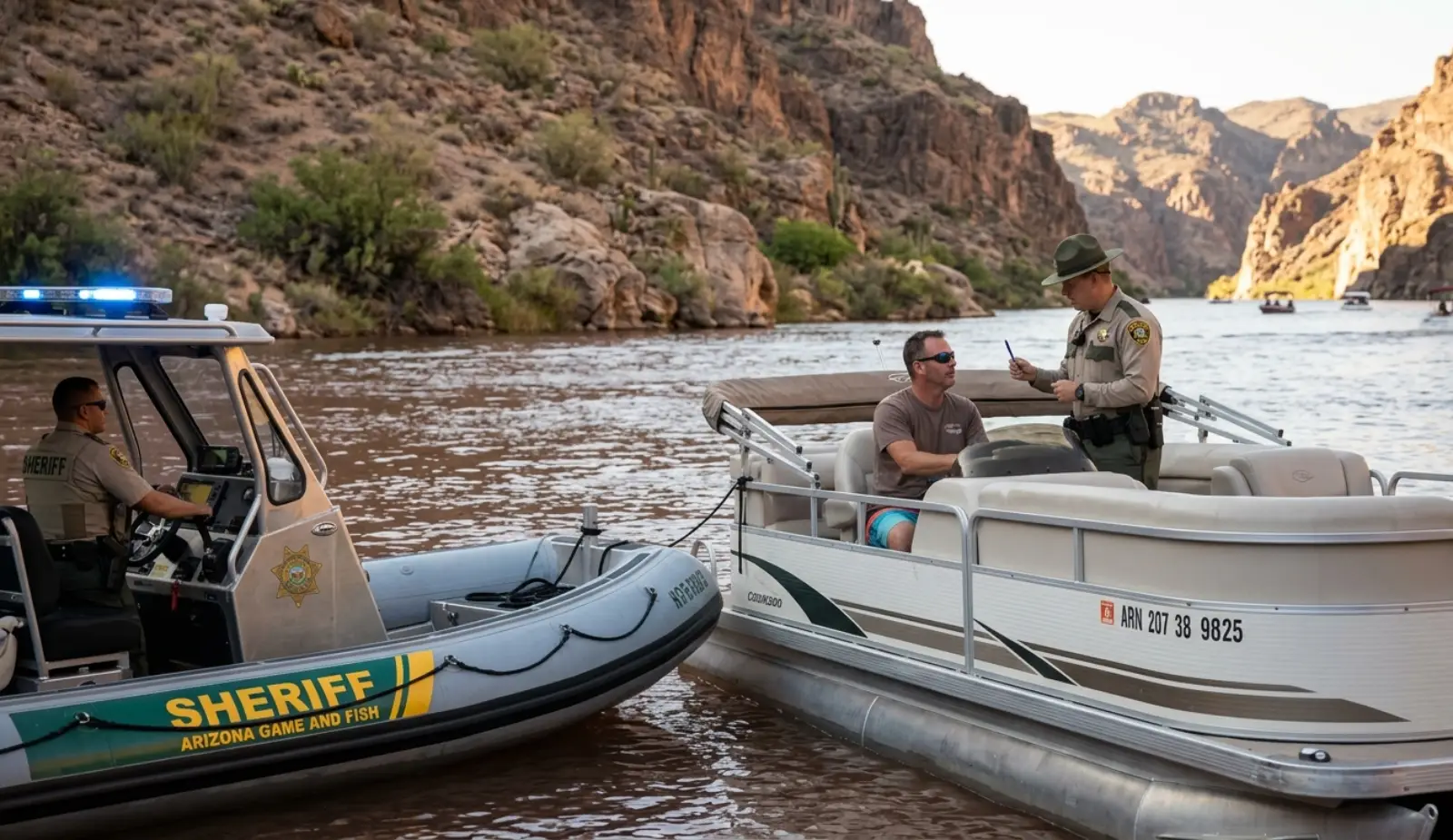
Picture it. It is a Saturday afternoon in July. The Colorado River is shimmering in the sun. You have got your boat out, some ice in the cooler, and a few friends along for the ride. Life is pretty good right about now. You crack open a cold one and watch the jet skis go by.
And then you see the lights.
An Arizona Game and Fish officer pulls alongside your boat. They are friendly enough, but they are watching. And if they smell alcohol — or if you look the least bit unsteady behind the wheel of that boat — your afternoon on the water is about to take a very sharp turn. What most people do not realize is that a DUI on the Colorado River near Bullhead City is absolutely a real thing. It is called an OUI — Operating Under the Influence — and it carries penalties that are almost identical to a DUI on land.
I am Keith Knochel. My firm, Knochel Law Offices, has been practicing criminal defense law right here in Bullhead City since 1982. We have handled DUI cases, criminal charges, and river-related incidents for over four decades. Every summer, we get calls from people who had no idea that the same rules that apply on Highway 95 also apply on the river. Now you will know before that moment ever comes.
This article will walk you through exactly what Arizona’s boating DUI law says, what the real penalties look like, and what your options are if you or someone you care about gets charged. Let’s get into it.
📋 KEY TAKEAWAYS — WHAT YOU NEED TO KNOW BEFORE YOU GET ON THE WATER
- Yes, you absolutely can be charged with a DUI on the Colorado River in Arizona. It is called an OUI (Operating Under the Influence) under ARS § 5-395.:Yes, you absolutely can be charged with a DUI on the Colorado River in Arizona. It is called an OUI (Operating Under the Influence) under ARS § 5-395.
- The legal BAC limit on the water is the same as on land: 0.08%. Commercial operators are held to an even stricter 0.04%.
- You can be charged even BELOW 0.08% if an officer believes you are impaired “to the slightest degree.”:You can be charged even BELOW 0.08% if an officer believes you are impaired “to the slightest degree.”
- A first-offense OUI carries a minimum of 10 days in jail and fines starting at $1,250 — plus court fees and surcharges.:A first-offense OUI carries a minimum of 10 days in jail and fines starting at $1,250 — plus court fees and surcharges.
- Alcohol is the #1 contributing factor in fatal boating accidents nationally, according to the U.S. Coast Guard.:Alcohol is the #1 contributing factor in fatal boating accidents nationally, according to the U.S. Coast Guard.
- A BUI conviction stays on your record and counts toward repeat-offense penalties for 84 months (7 years).:A BUI conviction stays on your record and counts toward repeat-offense penalties for 84 months (7 years).
- Arizona’s implied consent law applies on the water just like it does on the road. Refusing a chemical test is a separate criminal charge.:Arizona’s implied consent law applies on the water just like it does on the road. Refusing a chemical test is a separate criminal charge.
- Our attorneys at Knochel Law Offices have defended criminal charges in Mohave County courts since 1982. Call us the moment you are charged.:Our attorneys at Knochel Law Offices have defended criminal charges in Mohave County courts since 1982. Call us the moment you are charged.
Can You Actually Get a DUI on the Colorado River in Arizona — Is That a Real Charge?
Yes. Absolutely yes. And this surprises more people than you would think.
In Arizona, the law that governs drinking and driving a boat is called ARS § 5-395. It is the Operating Under the Influence statute, and it applies to any motorized watercraft operating in Arizona waters. That means your speedboat, your pontoon boat, your WaveRunner, your SeaDoo, your jet ski — if it has a motor and it is on the Colorado River near Bullhead City, Laughlin, or Lake Havasu, this law applies to the person running it.
The exact wording of the statute says it is unlawful for any person to “operate or be in actual physical control of a motorized watercraft that is underway within this state” while impaired. (Source: Arizona Revised Statutes § 5-395, via the Arizona Legislature.)
A few things stand out in that language. First, it says “operate OR be in actual physical control.” That means you do not even have to have your hand on the wheel. If you are sitting in the driver’s seat with the motor running and you are intoxicated, that can be enough for a charge. Second, it says “underway” — meaning anchored or moored boats in a designated slip are treated differently. But if your boat is moving, or capable of moving under its own power, you are subject to this law.
Here on the Colorado River, enforcement comes from multiple agencies. The Arizona Game and Fish Department patrols the river regularly during peak season. Mohave County Sheriff’s deputies are out on the water. The Nevada Department of Wildlife works the Laughlin side. And during busy summer weekends like the Fourth of July, officers from multiple agencies coordinate together. The river near Bullhead City sees serious enforcement, and the officers are experienced at spotting impaired operators.
What Is the Legal BAC Limit for Boating on the Colorado River — Is It Different from Driving?
Here is where it gets interesting. For most recreational boaters, the legal blood alcohol concentration (BAC) limit is the same as it is on the road: 0.08%. If your BAC is at 0.08% or higher within two hours of operating your boat, Arizona law presumes you were under the influence while you were running it. (Source: ARS § 5-395.)
But there is a catch that a lot of people miss entirely. Arizona law also says you can be charged if you are impaired “to the slightest degree” — even if your BAC is below 0.08%. That means an officer does not need a breathalyzer reading to justify a charge. If you are slurring words, if your coordination looks off, if your reaction time seems slow, if you smell strongly of alcohol — any of those observations can support an OUI arrest, even if your blood alcohol level technically sits below the legal limit.
That is a much lower bar than most people realize. And it is exactly the same standard that Arizona applies to car and truck drivers on land.
There is also a stricter rule for commercial watercraft operators. If you are running a commercial vessel — a tour boat, a water taxi, a guided fishing charter — your legal limit drops to a BAC of 0.04%. That is half the recreational limit. One or two drinks could push a commercial operator over that line. (Source: ARS § 5-395; Arizona Department of Public Safety.)
And here is a detail that almost nobody talks about: marijuana is legal in Arizona for adults over 21. But legal marijuana is NOT a defense to an OUI charge on the water. If THC or any drug metabolite is detected in your system — even from marijuana you used legally, even if you feel completely fine — you can still be charged under ARS § 5-395. The law covers any drug or its metabolite, full stop. (Source: ARS § 5-395C; ARS § 13-3401.)
What Are the Real Penalties for a BUI on the Colorado River in Arizona?
Let’s talk numbers. Because this is where people’s eyes tend to get wide.
Arizona breaks OUI charges into several levels based on your BAC and your prior history. Here is what the penalties look like as of current Arizona law:
Standard OUI (BAC 0.08% to 0.149%):
- First offense: Minimum 10 days in jail (though up to 9 days may be suspended if you complete alcohol screening and treatment). Minimum fines of $1,250. Class 1 misdemeanor.
- Second offense within 84 months: Minimum 90 days in jail. Minimum fines of $3,000. Class 1 misdemeanor.
- Third offense within 84 months: Upgraded to Aggravated OUI — a Class 4 felony. Minimum 4 months in state prison. Fines up to $4,000. The state can also move to forfeit your watercraft.
Extreme OUI (BAC 0.15% to 0.199%):
- First offense: Minimum 30 days in jail. Minimum fines of $2,700. Class 1 misdemeanor with steeper penalties than standard OUI.
Super Extreme OUI (BAC 0.20% or higher):
- First offense: Minimum 45 days in jail. Minimum fines of $3,150. Class 1 misdemeanor. (Source: Arizona Game and Fish Department — Arizona Boating Safety; ARS § 5-395.01; ARS § 5-397.)
Aggravated OUI — Two Extra Triggers You May Not Know About:
- Child passenger: If a passenger under the age of 15 is on your boat when you are charged with an OUI, the charge automatically escalates to Aggravated OUI — a felony — regardless of your BAC.
- Three or more OUI convictions: Three or more OUI offenses within 84 months also triggers the felony classification.
And here is a number almost nobody talks about: on top of all of these fines, Arizona adds a civil penalty of $500 upon conviction. Plus court fees. Plus mandatory alcohol screening fees. Plus potential probation costs. A first-offense OUI that starts at $1,250 in fines often ends up costing $3,000 to $5,000 or more by the time everything is tallied up. (Source: ARS § 5-395.01; Arizona Boat-Ed program — Arizona boating penalties.)
And then there is the non-financial cost: the criminal record. An OUI conviction does not just disappear. It stays on your record, and it counts toward repeat-offense escalation for seven full years — 84 months. That means a second water-related incident within that window could turn what would have been a misdemeanor into a felony charge with mandatory prison time.
Why Is the Colorado River Near Bullhead City So Dangerous When Alcohol Is Involved?
Here is a national statistic that does not get nearly enough attention. In 2023, alcohol was the single leading known contributing factor in fatal boating accidents across the United States — responsible for 79 deaths, which represented 17 percent of all boating fatalities that year. (Source: U.S. Coast Guard 2023 Recreational Boating Statistics Report.)
Let that number sink in for a second. Not excessive speed. Not operator inexperience. Not equipment failure. Alcohol. It was the number one killer.
The 2024 data shows similar patterns, with the fatality rate on recreational vessels at 4.8 deaths per 100,000 registered boats. And here is a shocking secondary stat: of all fatal boating accident victims where the cause of death was known, 87% of drowning victims were not wearing a life jacket in 2024. (Source: National Safe Boating Council, citing U.S. Coast Guard 2024 Recreational Boating Statistics.) That combination — alcohol impairment plus no life jacket — is exactly how tragedies happen.
The Colorado River near Bullhead City is a particularly challenging environment. Here is why:
- Heavy boat traffic: On summer weekends, the stretch between Laughlin and Lake Havasu can get extremely crowded. The combination of high-speed watercraft, personal watercraft, tubers, and swimmers in close proximity requires sharp attention and fast reaction times. Alcohol eats into both.
- Sun exposure and dehydration: Research shows that sun, heat, wind, and engine vibration on the water can accelerate the effects of alcohol on the body — making you feel more impaired than you might on land after the same number of drinks. The desert heat along the Colorado River corridor is not forgiving.
- No lane markings: Unlike a highway, there are no painted lines on the water. Navigation requires active judgment at all times. Impaired operators struggle with spatial awareness and distance estimation.
- Cross-border jurisdiction: The Colorado River forms the Arizona-Nevada border. Agencies from both states patrol it. There is no easy way to slip across to the other side and be “out of jurisdiction.”
In 2018, a deadly head-on collision between two boats north of Lake Havasu killed three people and injured many more — a crash that happened right in the heart of the same river corridor our clients in Bullhead City travel on every weekend. None of the people ejected into the water were wearing life jackets. (Source: Arizona Boating World / Arizona Game and Fish Department report, 2018.) These accidents happen fast, and alcohol makes them happen faster.
What Is Arizona’s Implied Consent Law for Boaters — And What Happens If You Refuse a Chemical Test?
This is one of the most misunderstood parts of Arizona’s boating law — and one of the most important things our attorneys want you to know before you get on the water this summer.
Arizona’s implied consent law applies to boaters the same way it applies to drivers. What does that mean? It means that by operating a motorized watercraft in Arizona waters, you have legally consented to submit to a breath test, blood test, or urine test if a law enforcement officer arrests you on suspicion of OUI. You gave that consent the moment you turned the key and headed out on the river.
Here is where people make a costly mistake: they think refusing the test is a smart move. It is not. Under ARS § 5-395.03, refusing a chemical test after an OUI arrest is itself a separate criminal charge — a Class 1 misdemeanor — and it also carries an additional fine of up to $750 on top of that. (Source: ARS § 5-395.03; Arizona Boat-Ed Safety Program.)
Now, there IS a distinction between the preliminary breath test (PBT) that officers use before an arrest and the formal chemical test administered after an arrest. You can refuse the preliminary roadside-style breath test. Your refusal of the PBT cannot be used as direct evidence against you — but it CAN be considered by the officer as one more factor in the decision to arrest you. The formal chemical test is the one you are legally obligated to submit to after an arrest has been made.
One more thing people do not realize: even if you pass the breath test, you can still be charged. If an officer observes signs of drug impairment — red eyes, slow speech, unusual behavior — they can request a blood or urine test to look for drug metabolites. And as we covered earlier, the presence of any drug metabolite in your system is an OUI violation regardless of how impaired you actually feel.
Our attorneys at Knochel Law Offices handle criminal defense cases — including BUI, OUI, and DUI charges — across Bullhead City, Kingman, and Lake Havasu City. If you have questions about your rights on the water, visit us at lawyersinarizona.com — Criminal Defense.
What Are the Best Ways to Enjoy the Colorado River Without Getting Charged with a BUI?
We want you to have a great summer on the water. Truly. The Colorado River near Bullhead City is one of the best places in the country to boat, swim, tube, and fish. The goal is to make sure you are enjoying it from your boat — not from a jail cell.
Here are the things our attorneys want every boater near me in the Bullhead City area to know before the season kicks off:
Designate a sober operator, and stick to it.
Just like a designated driver on land, pick someone on your boat who commits to staying sober for the trip. Rotate that responsibility on different days. The best thing you can do for your crew is make sure the person behind the wheel is 100% clear-headed.
Know that the sun and heat change the equation.
Two beers on a hot Arizona river day can feel like four beers on land. Dehydration, sun exposure, and engine vibration combine with alcohol in ways that speed up impairment. Drink water regularly. Take breaks in the shade. This is not just about avoiding a charge — it is about keeping yourself and your passengers safe.
Wear your life jacket.
Arizona law requires that anyone 12 and under must wear a life jacket at all times when the vessel is underway. But as the national stats show — 87% of drowning victims in fatal boating accidents were not wearing one — adults need to wear them too. Especially if alcohol is on the boat. You can buy the best life jacket on the market and it does absolutely nothing sitting in a storage compartment when you need it.
Pull over and anchor if you have been drinking.
If you have had too much and you are out on the water, pull over to a legal anchorage area and wait. The key phrase in ARS § 5-395 is “underway” — a vessel that is properly anchored is in a different legal status than one that is moving. This is not a guaranteed escape from a charge if an officer investigates, but stopping the boat is always better than continuing to operate it impaired.
Do not assume you are out of reach because you are near the Nevada side.
Multiple agencies patrol the Colorado River. The Arizona side, the Nevada side, and federal waters are all covered. There is no safe side of the river when it comes to impaired operation enforcement.
What Should You Do If You Are Charged with a BUI or OUI on the Colorado River in Arizona?
Getting charged with a boating DUI is frightening. The good news is that being charged is not the same as being convicted. The law in Arizona gives you rights — and there are real defenses available in OUI cases that our attorneys at Knochel Law Offices explore for every client.
Here is what you should do the moment you are charged:
- Stay calm and be polite with the officers.
- Invoke your right to remain silent. You do not have to answer questions beyond identifying yourself.
- Submit to the formal chemical test after arrest — refusing creates an additional charge and fine.
- Ask to speak with an attorney before answering any questions. You have that right.
- Write down everything you remember as soon as possible — weather, water conditions, how many drinks you had and over what time frame, what the officer said, and exactly what happened.
- Call Knochel Law Offices. The sooner you call us, the more time we have to build your defense.
What kinds of defenses exist in OUI cases? There are several, and they are very fact-specific. Some of the most common include:
- Lack of probable cause: Did the officer have sufficient legal reason to stop your vessel in the first place? If not, evidence gathered during the stop may be challengeable.
- Chain of custody issues with chemical test results: Were blood or urine samples collected, stored, and tested properly? Errors in the process can undermine the evidence.
- The watercraft was not “underway”: If the vessel was anchored, moored, or aground at the time of contact, the “underway” requirement of ARS § 5-395 may not be met.
- Prescription medication defense: ARS § 5-395C provides an exception for drug metabolites if the defendant had a valid prescription for the drug. This is a narrow but real defense.
- Timing of testing: The law requires a BAC of 0.08% within two hours of operating the vessel. How much time passed between operation and testing? Was the test administered properly?
These defenses require skill, experience, and a thorough understanding of Arizona’s boating statutes. Our attorneys have handled criminal defense cases in Mohave County courtrooms for over four decades. We know these statutes inside and out, and we know what questions to ask.
Our firm handles the full range of criminal defense cases — DUI, OUI, BUI, assault, drug charges, and more. Learn more at lawyersinarizona.com — Criminal Defense, or visit our full practice areas overview at lawyersinarizona.com — Practice Areas.
How Does a BUI Conviction on the Colorado River Affect the Rest of Your Life in Arizona?
People sometimes think of a BUI as a lesser offense — like it is just a boating thing, not a “real” DUI. Our attorneys hear this in client meetings all the time. And it is completely wrong.
A first-offense OUI in Arizona is a Class 1 misdemeanor — the same classification as a first-offense DUI on the road. It sits on your criminal record. It can come up in background checks. It can affect your employment, especially in any job that involves operating vehicles, watercraft, or equipment. It can affect professional licensing. In some cases, it can complicate immigration status.
And here is the long-term sting: that conviction counts toward escalating repeat-offense penalties for 84 months — seven full years. That means if you are charged with a second OUI within that window, you are looking at mandatory minimums that are nearly nine times worse than a first offense. And a third offense? That is a felony. A felony is a completely different category of legal consequence — loss of voting rights, potential loss of firearm rights, and permanent damage to your background check.
A BUI conviction that starts as a “just a boating thing” can end up reshaping your life in ways you never anticipated. That is exactly why our attorneys take these charges seriously from the first phone call, and exactly why we recommend calling us before you say anything to law enforcement beyond your name.
Our firm also handles Divorce and Family Law, Elder Law, Business Law, Real Estate Law, and Wills, Estates and Probate — because we know that a criminal charge rarely affects just one part of someone’s life. Find out more about everything our team offers at lawyersinarizona.com.
Why Are Knochel Law Offices the Right Choice for a BUI or Criminal Charge in Bullhead City?
I want to be real with you for a second. When you are facing a criminal charge — whether it is a BUI on the Colorado River, a DUI on Highway 95, or any other serious criminal matter — the attorney you choose genuinely matters. This is not a situation where every option is the same.
Here is why families and individuals in Bullhead City, Kingman, and Lake Havasu City have trusted our team at Knochel Law Offices since 1982:
- We have been doing this since before most people in Bullhead City were born. 1982 is not a marketing line. It means our attorneys have watched Arizona law change, watched courts evolve, and built real relationships in Mohave County’s legal community over decades.
- We are licensed in Arizona, Nevada, AND California. The Colorado River is a tri-state waterway. BUI charges near Bullhead City can involve Arizona Game and Fish officers, Nevada wildlife officers, and federal agencies. Our multi-state licensing means we understand the jurisdictional picture in a way that many local attorneys simply do not.
- We handle the full picture of your legal life. A BUI charge can ripple into your family situation, your business, your real estate, and your estate planning. Our firm practices Criminal Defense, Personal Injury Law, Divorce and Family Law, Business and Commercial Law, Elder Law, Real Estate Law, and Wills, Estates and Probate. You get the best support from a team that sees the whole person, not just the charge.
- We have three offices — we are always near me when you need us. Bullhead City is our home. We also have satellite offices in Kingman and Lake Havasu City. You will never have to drive to Phoenix to talk to a real attorney about your case.
- We communicate clearly and honestly. We tell you what you are facing. We tell you what your options are. We do not hide behind legal language.
If you have been charged with a BUI, OUI, or any related criminal offense on the Colorado River or anywhere in the Tri-State Area, call us immediately.
📞 928-444-1000 | www.lawyersinarizona.com | 1967 Highway 95, Bullhead City, AZ 86442
Helpful External Resources for Arizona Boaters
These official government and public resources can help you understand your rights, learn boating safety requirements, and navigate the law:
• Arizona Revised Statutes § 5-395 — Operating Under the Influence: ARS § 5-395 via Arizona Legislature — The actual boating DUI statute that applies on the Colorado River.
• Arizona Game and Fish Department — Boating Safety: azgfd.com/Boating — Official boating regulations, licensing requirements, and safety rules for Arizona waterways.
• U.S. Coast Guard — Recreational Boating Statistics 2023: uscgboating.org — Annual national data on boating fatalities, injuries, and alcohol-related incidents.
• National Safe Boating Council — Recreational Boating Facts: safeboatingcouncil.org — Life jacket statistics and boating safety education data.
• Arizona Judicial Branch — Criminal Case Information: azcourts.gov — Find Mohave County court locations, filing information, and case lookup tools.
8 Questions Bullhead City Residents Ask About BUI / OUI Charges on the Colorado River
Q1: Is a BUI on the Colorado River treated the same as a DUI on land in Arizona?
For all practical purposes — yes. The penalties for an OUI (Operating Under the Influence) under ARS § 5-395 are nearly identical to those for a DUI under ARS § 28-1381. First-offense OUI carries a minimum 10 days in jail, fines starting at $1,250, and a Class 1 misdemeanor on your record. The same tiered system for Extreme OUI (BAC 0.15–0.199%) and Super Extreme OUI (BAC 0.20%+) applies on the water. Our attorneys treat a BUI charge with the same seriousness as any DUI case — because the consequences are just as serious.
Q2: What happens if I refuse a breath test on the Colorado River in Arizona?
Refusing a formal chemical test after an OUI arrest is itself a separate criminal charge — a Class 1 misdemeanor — and adds an additional fine of up to $750 under ARS § 5-395.03. Arizona’s implied consent law covers boaters the same way it covers drivers on the road. Refusing doesn’t make the charge go away. It just adds another charge on top. If you are pulled over on the river and arrested, call our attorneys immediately at 928-444-1000 before you make any decisions about testing.
Q3: Can I be charged with an OUI if I feel fine and I’m below 0.08%?
Yes. Arizona’s OUI law includes a “slightest degree” standard. That means if a law enforcement officer observes signs of impairment — unsteady balance, slurred speech, slow reactions, red or glassy eyes, or the odor of alcohol — they can arrest you for OUI even if your BAC tests below 0.08%. The presence of any drug metabolite in your system (including legal marijuana) also constitutes an OUI violation under ARS § 5-395, regardless of actual impairment. This is one of the reasons having an experienced attorney review your case is so important.
Q4: Does a passenger on my boat need to worry about open container laws in Arizona?
Somewhat. Passengers on a recreational boat are generally not restricted from having open alcoholic beverages on board — Arizona’s open container law under ARS § 4-251 targets operators and drivers of motor vehicles, not passengers on watercraft. However, the operator of the vessel should never have an open container within their reach while underway, and the operator’s BAC is the central legal issue. Our attorneys always recommend that boat operators stay completely sober and let passengers handle the cooler.
Q5: What if the BUI happened in Nevada, near Laughlin? Which state handles the charge?
The law of the state where the incident occurred governs the charge. If you were on the Nevada side of the Colorado River when you were arrested, Nevada’s BUI laws apply. The good news is that Knochel Law Offices is licensed in Nevada as well as Arizona and California. Our attorneys can handle BUI and criminal defense matters on either side of the river — one of the few firms in the Tri-State Area with that capability. You do not need to scramble to find a different attorney for a Nevada charge.
Q6: Can a BUI conviction affect my driver’s license on land in Arizona?
An OUI conviction is a separate offense from a DUI and is governed by the Arizona boating statutes rather than the motor vehicle code. In most cases, a first-offense OUI does not result in an automatic suspension of your driver’s license the way a DUI does. However, it is a criminal conviction that goes on your record. If you are convicted of Aggravated OUI — the felony level — the consequences become far more sweeping and CAN affect your driving privileges and other civil rights. The specifics depend heavily on the details of your case, which is exactly why you need our attorneys reviewing your situation before you accept any plea.
Q7: What if a minor was on my boat when I was charged with a BUI in Arizona?
This is one of the most serious aggravating factors in Arizona boating law. If a child under the age of 15 is a passenger on your watercraft when you are charged with an OUI, the charge automatically escalates to Aggravated OUI under ARS § 5-396 — regardless of your BAC level and regardless of whether it is your first offense. That is a felony classification. Aggravated OUI carries a minimum of 4 months in state prison, up to $4,000 in fines, and the possibility of watercraft forfeiture. If you are facing this situation, call our attorneys immediately. Do not attempt to navigate a felony charge without experienced legal counsel in your corner.
Q8: How long does a BUI conviction stay on my record in Arizona?
An OUI conviction in Arizona is a permanent part of your criminal record. It never automatically disappears. However, the window that matters most for repeat-offense sentencing escalation is 84 months — or seven years. Within that window, a second OUI conviction carries dramatically worse penalties (minimum 90 days in jail, $3,000 in fines), and a third conviction becomes a Class 4 felony. If you received an OUI conviction and you want to understand your options for record-sealing or expungement under Arizona’s new laws, our attorneys can review your specific situation and advise you on what may be possible.
Have You Been Charged with a BUI or OUI on the Colorado River?
Call Knochel Law Offices — Bullhead City | Kingman | Lake Havasu City📞 928-444-1000