
Facing Holiday Shifts: What are the Arizona Employer Obligations for Christmas and New Year’s Overtime?
When December hits, everyone starts thinking about Christmas Day, New Year’s Eve, and those big holiday bonus checks. But for business owners, the holidays bring a headache: scheduling and pay.
Should I pay time-and-a-half for Christmas Day? Do I have to pay anything extra at all? What happens if an employee works 50 hours during a busy holiday week?
The law around holiday work is confusing because it involves both state rules (Arizona) and federal rules (the USA government). The good news is that the rules are actually quite clear once you know where to look.
We want to share the facts and show you the best way to handle pay during this busy season. This article is your expert guide to understanding Arizona employer obligations, making sure employees get what they earned, and keeping your business running smoothly near me.
1. The Big Misunderstanding: Holiday Pay vs. Overtime
Let’s start with the one fact that surprises most people in Arizona.
Does Arizona Law Require Employers to Pay Extra on Christmas Day? (No!)
This is the key difference between Holiday Pay and Overtime.
- Holiday Pay: This is when an employer pays time-and-a-half (1.5 times the normal rate), double-time, or even pays an employee to stay home on a holiday.
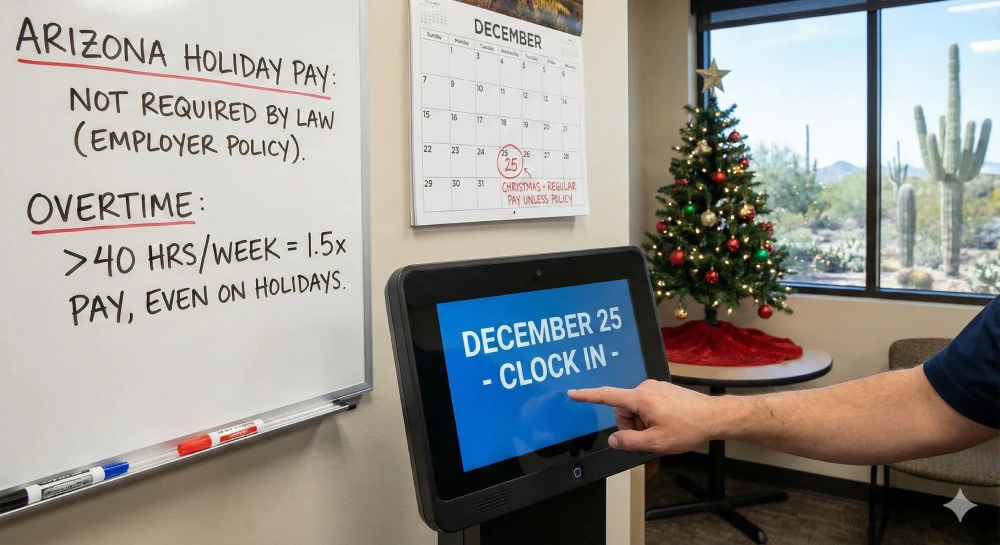
- The Arizona Rule: Arizona law does NOT require private employers to pay extra for working on a holiday (like Christmas or New Year’s Day). There is no state law that forces you to pay time-and-a-half for the holiday itself.
- The Reality: Holiday pay is a benefit. It is something the employer offers voluntarily to attract the best workers and show thanks. If your employee handbook or contract promises holiday pay, then you must pay it, but the law itself doesn’t mandate it.
- Overtime: This is when an employer must pay an employee extra for working too many hours in a workweek.
- The Federal Rule: This is mandatory under the federal Fair Labor Standards Act (FLSA). If a non-exempt employee works more than 40 hours in a standard workweek, those extra hours must be paid at time-and-a-half (1.5 times the regular rate of pay).
The bottom line for businesses in Bullhead City is: You don’t legally have to pay extra for Christmas, but you absolutely must pay overtime if the employee hits 40 hours.
The Hidden Stat: When Overtime Becomes a Bigger Risk
Most people focus on the big national chains when thinking about labor law, but small businesses in Kingman or Lake Havasu often face higher risks of making simple, costly mistakes.
- Stat You Need to See: According to the U.S. Department of Labor (DOL), wage and hour violations—especially related to incorrect overtime calculation—are one of the most common reasons for businesses to face audits or lawsuits. A single, small mistake, repeated over hundreds of shifts during the holiday rush, can lead to thousands of dollars in back wages owed, plus penalties.
This is why having clear pay policies is the best defense for your small business.
2. Calculating Overtime During a Holiday Week
The holiday itself doesn’t change the 40-hour rule, but it often causes employers to miscalculate what counts toward those 40 hours.
What Hours Count Toward the Mandatory 40-Hour Overtime Threshold?
The mandatory overtime rule is about hours physically worked.
- Hours That Count: Every hour an employee spends doing work for your business must be counted towards the 40-hour limit.
- Hours That Do NOT Count: If you pay an employee for a day off for Christmas (Holiday Pay benefit), those paid hours do not count toward the 40-hour federal overtime limit.
A Quick Math Example (The Best Way to Calculate)
Let’s look at two employees at a retail store in Bullhead City that pays $20/hour.
| Employee | Hours Worked (Actual Time) | Paid Holiday (Benefit) | Total Hours Paid | Overtime Owed? |
| Employee A | 45 hours | 0 hours | 45 hours | YES! (5 hours at $30/hr) |
| Employee B | 35 hours | 8 hours (for Christmas Day) | 43 hours | NO! (Only 35 hours actually worked) |
The Lesson: For federal overtime, only Employee A, who actually worked 45 hours, gets the overtime rate. Employee B, who worked 35 hours and got 8 hours of holiday pay as a bonus, does not qualify for federal overtime because they didn’t pass the 40-hour work limit.
The Salaried Employee Trap
Many business owners think that if they pay someone a salary, they never have to pay overtime. This is a huge, expensive mistake.
- The Rule: Just because an employee is paid a salary does not mean they are exempt from overtime. To be truly exempt (meaning you don’t owe them overtime), they must pass three strict tests:
- Salary Basis Test: They must be paid a minimum set salary (currently over $684 per week).
- Salary Level Test: They must pass the minimum salary threshold.
- Duties Test: They must perform specific executive, administrative, or professional duties.
Many managers or assistant managers in retail or services near me who are paid a salary are actually non-exempt. If they are non-exempt, you must track their hours, and you owe them time-and-a-half for every hour they work over 40.
Internal Link Opportunity: Misclassifying employees is a huge risk. If you are concerned about your business structure, find out more about our [Business and Commercial Law] (https://www.google.com/search?q=https://lawyersinarizona.com/business-commercial-law-bullhead-city-az/) services and compliance checks.
3. Mandatory Benefits: What Arizona Businesses Must Provide
Since Arizona doesn’t mandate paid holidays, what does the law say you must provide? This is important for new businesses or those looking for the best compliance.
The Two Required Leave Policies in Arizona
Arizona has two laws that are very important for employers, especially around sick days.
- Arizona Minimum Wage and Paid Sick Leave Act: This state law requires almost all Arizona employers to provide paid sick time to employees.
- The Amount: Employees earn 1 hour of paid sick time for every 30 hours worked.
- The Lesson: This is a state-mandated benefit, not a voluntary one. If an employee is sick over the holidays, you must let them use this paid sick time.
- Federal Family and Medical Leave Act (FMLA): This federal law gives employees the right to take unpaid, job-protected leave for certain family and medical reasons. This applies to businesses with 50 or more employees.
Stat You Need to See: According to the Bureau of Labor Statistics (BLS), while $77\%$ of private industry workers receive paid holidays, only about $32\%$ of workers in the lowest wage categories receive this benefit. This highlights why low-wage workers often choose to work the holidays—they need the money, even without extra pay.
The Time-Off Request Trap
During the busy holidays, employees might request vacation time. The best practice is to have a written, clear policy for handling requests.
- The Legal Rule: Arizona law does not require private employers to provide paid vacation time. If you offer it, you must follow your own policy. However, once an employee earns vacation time, it is considered wages.
- The Trap: If an employee quits or is fired in January, Arizona law states that you must pay them for all their accrued, unused vacation time in their final paycheck, unless your written policy explicitly says otherwise.
4. Key Takeaways from Knochel Law Firm
After over 40 years of advising employers and employees in Mohave County, here are the most important things Keith and Aline want you to remember about holiday pay:
- Holiday Pay is Voluntary: Arizona law does not force you to pay time-and-a-half for Christmas or New Year’s Day. If you choose to offer it, put it in writing.
- Overtime is Mandatory: The 40-hour rule is federal law (FLSA) and applies to most workers. If a non-exempt employee works 41 hours, you owe them 1 hour of overtime at $1.5$ times their regular rate.
- Track the Hours Worked: When calculating overtime, only count the hours the employee actually worked. Paid time off (like holiday pay or sick time) does not count toward the 40-hour overtime limit.
- Watch Salaried Staff: Don’t assume a salary means no overtime. Most salaried workers still qualify for overtime pay unless they pass the strict federal Duties Test.
- Review Final Paychecks: If an employee leaves in the new year, you must pay out all earned, unused vacation time, as it is considered wages under Arizona law.
5. Common Questions for Bullhead City Area Business Law Lawyers
Here are the five most common questions we get asked by business owners and employees facing holiday work issues in the Bullhead City, Kingman, and Lake Havasu areas that directly relate to this content:
1. Can I make my employees work on Christmas Day, even if they don’t want to?
Answer: Yes, generally. Unless the employee has a contract or union agreement that says otherwise, an employer in Arizona can require an employee to work any scheduled shift, including holidays. An employee who refuses to come to work can usually be disciplined or fired, as there is no specific law protecting the refusal of a holiday shift.
2. We use a four-day, 10-hour shift schedule. When does overtime kick in for us?
Answer: This is a key question for businesses near me in Mohave County. Arizona does not have a daily overtime rule (unlike California). Therefore, if your employees work four 10-hour shifts (40 hours total) in one week, you do not owe them overtime. Overtime only kicks in once they exceed 40 hours for the entire week.
3. I own a small business with only 5 employees. Do I still have to follow the 40-hour overtime rule?
Answer: Yes, almost certainly. The federal FLSA (which sets the 40-hour rule) covers nearly all employees of companies that engage in interstate commerce or have at least two employees and a certain minimum gross volume of sales. If your business uses the mail, credit cards, or the internet, you are likely covered and must follow the 40-hour rule.
4. If I pay my employee double-time for Christmas Day, do I still have to pay federal overtime if they work over 40 hours?
Answer: Yes, you do. The double pay for the holiday is considered a premium benefit, but it does not remove the FLSA obligation. The best way to calculate this is complex: The federal overtime rate is $1.5$ times the regular rate. You still owe that $1.5$ premium on any hours over 40, even if the holiday pay was higher. You need to credit the holiday pay you already paid against the overtime calculation.
5. My written policy says I pay out up to 80 hours of accrued vacation time when an employee leaves. Is that legal in Arizona?
Answer: Yes, and that is a best practice for protecting your business. Because Arizona treats accrued vacation time as earned wages, if your policy is silent, you would have to pay out all of it. By having a clear, written policy that “caps” the payout at 80 hours, you have defined the wage, and the court will uphold your written policy.
🔗 Resources and Further Reading
For more information on the laws discussed in this article, please visit the following pages on our website:
- Business and Commercial Law: https://lawyersinarizona.com/business-commercial-law-bullhead-city-az/ (For all business formation, compliance, and contract review needs)
- Real Estate Law: https://lawyersinarizona.com/real-estate-law-bullhead-city-az/ (For commercial leasing and property issues related to your business)
- Criminal Law: https://lawyersinarizona.com/criminal-law-bullhead-city-az/ (For addressing issues like theft or vandalism that can spike during the holidays)
- General Legal Practice Areas: https://lawyersinarizona.com/legal-practice-areas-bullhead-city-az/ (For comprehensive Mohave County legal services)
Authoritative Sources
We recommend reviewing these official, non-competitor resources for legal and public safety information:
- U.S. Department of Labor (DOL) – Fair Labor Standards Act (FLSA): https://www.dol.gov/agencies/whd/flsa (The primary federal source for the mandatory 40-hour overtime rule and exemption tests)
- Arizona Industrial Commission (ICA) – Minimum Wage and Paid Sick Leave: https://www.azica.gov/labor-minimum-wage-main-page (Official state resource for mandatory Arizona sick leave requirements)
- U.S. Department of Labor – Holiday Pay Fact Sheet: https://www.dol.gov/general/topic/pay/holiday (A federal explanation confirming that private employers are not federally required to provide holiday pay)
Arizona Revised Statutes (A.R.S.) – A.R.S. § 23-353 (Final Wages and Payment): https://www.azleg.gov/ars/23/00353.htm (The state statute governing when accrued vacation must be paid out upon separation from employment)