
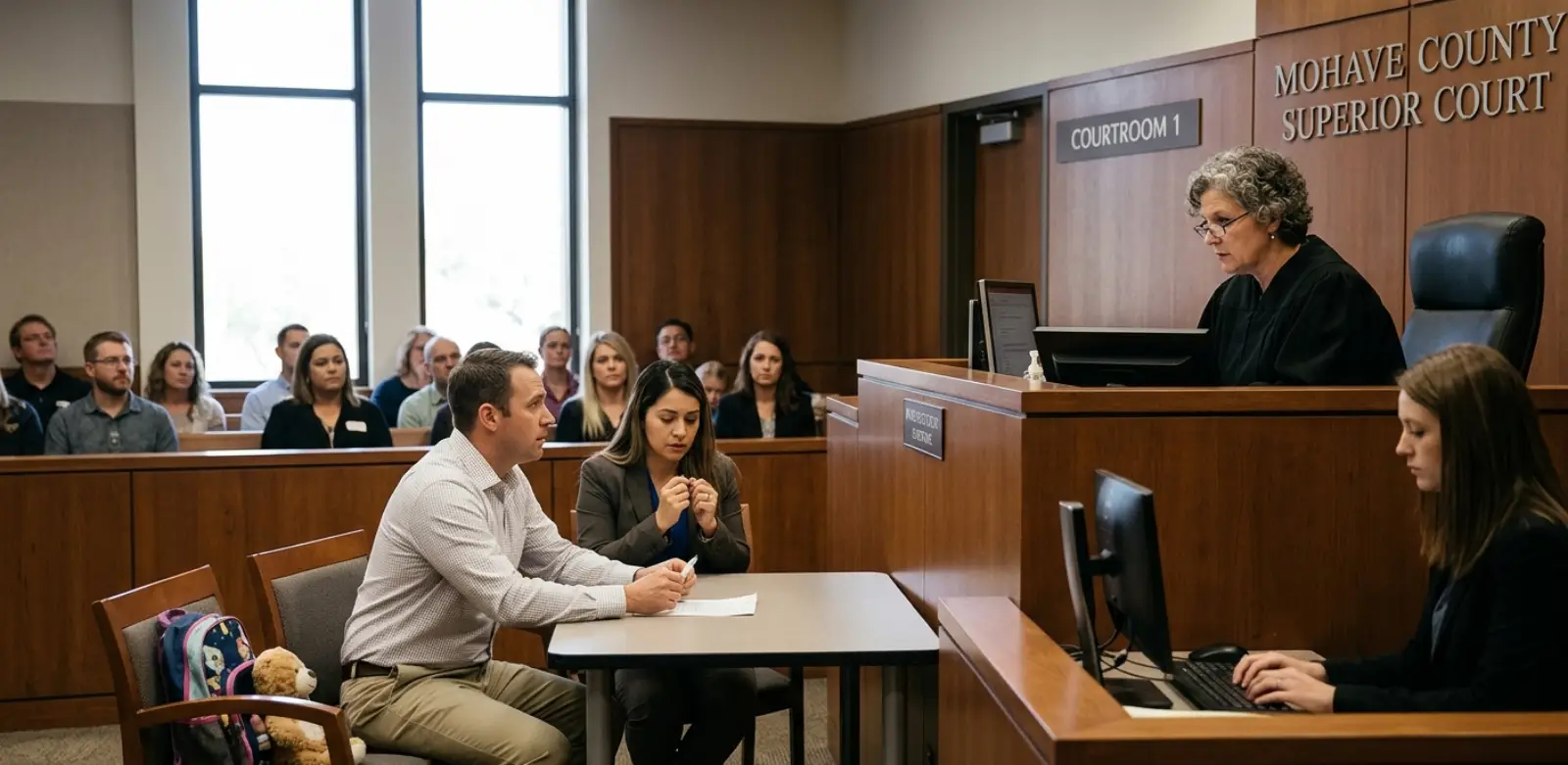
Custody cases are unlike any other type of legal battle. When you walk into a courtroom in Kingman or Bullhead City fighting for time with your child, the stakes are as high as they get. You are not arguing over money or property. You are arguing over your relationship with your own kid.
And the judge sitting across from you is watching. Carefully.
What most parents do not realize — and what I want to tell you clearly today — is that Arizona family court judges do not make custody decisions based on instinct or personal opinion. They follow a specific legal framework. There are 11 defined factors written directly into Arizona law that every judge in Mohave County is required to consider when deciding legal decision-making and parenting time. If you do not know what those factors are, you cannot present yourself in the best possible light against them.
I am Keith Knochel. My firm, Knochel Law Offices, has been helping families in Bullhead City, Kingman, and Lake Havasu City navigate divorce and custody proceedings since 1982. Over those four-plus decades, we have sat in Mohave County Family Court more times than we can count. We know how these cases are decided. And in this article, I am going to walk you through exactly what a judge is evaluating — and what you can do about it.
This is not legal advice for your specific case. Every family situation is different, and you should talk to our attorneys about your individual circumstances. But this will give you a real, working understanding of how Arizona law approaches child custody — and that knowledge alone can make a significant difference in how you prepare.
📋 KEY TAKEAWAYS — WHAT EVERY MOHAVE COUNTY PARENT NEEDS TO KNOW
- Arizona uses 11 specific legal factors to decide custody — all of them written into ARS § 25-403. Judges are required by law to consider every single one.
- Arizona courts start from a presumption of equal parenting time. The law states that children benefit from spending as much time with each parent as possible, absent evidence to the contrary.
- Arizona calls custody by two different names. Legal decision-making (who makes major life decisions for the child) and parenting time (the physical schedule) are handled separately.
- Domestic violence is an automatic game-changer. Under ARS § 25-403.03, a finding of significant domestic violence creates a legal presumption AGAINST awarding custody to the abusive parent.
- Your social media can and will be used against you. Posts, photos, and even private messages can be introduced as evidence in a Mohave County custody proceeding.
- The parent who is more likely to support the other parent’s relationship with the child scores significantly better with Arizona judges. This single factor trips up more parents than almost any other.
- Arizona recorded 15,160 divorces in 2023. (Source: Arizona Department of Health Services.) Behind most of those are children whose lives are being shaped by custody decisions.
- Our attorneys at Knochel Law Offices have been handling family law cases in Mohave County courts since 1982. Call 928-444-1000 — we know these courtrooms and these judges.
What Does “Child Custody” Actually Mean in Arizona — and Why Does Mohave County Call It Something Different?
If you have been searching for information about child custody in Arizona, you may have noticed that Arizona courts use some unusual vocabulary. They do not say “custody” the way most people use the word. They use two separate terms — and understanding both is essential before you step foot in a Mohave County courtroom.
Legal Decision-Making:
This is the right and responsibility to make major decisions about your child’s life — things like where they go to school, what medical treatment they receive, what religion they are raised in, and how they are disciplined. In Arizona, the court can award sole legal decision-making to one parent, or joint legal decision-making to both. Joint decision-making does NOT mean equal time. It means both parents have input on the big life decisions. (Source: Arizona Revised Statutes § 25-403.01; Arizona Judicial Branch.)
Parenting Time:
This is the physical schedule — which days and nights each parent has the child. Parenting time can be equal (roughly 50/50), primary with one parent and visitation with the other, or any number of customized arrangements that fit the specific family situation. The court is not locked into any formula. It looks at what actually serves the child.
Why does this distinction matter? Because you can have joint legal decision-making with unequal parenting time, or sole legal decision-making with a near-equal physical schedule. These are separate decisions. And Arizona judges approach each one through the lens of the same overarching standard: the best interests of the child, as defined by ARS § 25-403.
Since 2018, Arizona courts have treated equal parenting time as a starting point — not a guarantee, but a presumption that the law says serves children’s best interests unless specific evidence points the other way. (Source: Arizona Court of Appeals; ARS § 25-403.02.) That presumption can be overcome, but the parent asking the court to deviate from it carries the burden of showing why.
What Are the 11 Factors Mohave County Judges Must Consider in Every Arizona Custody Case?
Here they are — straight from Arizona Revised Statutes § 25-403 — in plain language. In a contested custody case, a Mohave County judge is required to make specific written findings on the record about every relevant factor. Not just the ones that favor one parent. All of them. (Source: ARS § 25-403; Arizona Legislature.)
Factor 1: The past, present, and future relationship between each parent and the child.
This is about the history of involvement. Which parent has been the primary caregiver? Who gets the kids ready for school? Who takes them to doctor appointments? Who coaches little league or helps with homework? A parent who has been consistently present has a strong starting position on this factor. A parent who has been frequently absent — even for understandable reasons like work — faces more scrutiny.
Factor 2: How the child interacts with each parent, siblings, and other significant people in their life.
Judges look at the quality of each parent’s relationship with the child, the child’s relationship with any siblings, and whether there are significant other people — stepparents, grandparents, a parent’s new partner — who play a meaningful role. Positive, stable relationships count in your favor. Chaotic, unstable, or harmful ones can cut the other way.
Factor 3: The child’s adjustment to home, school, and community.
Stability is one of the biggest themes in Arizona custody law. A judge wants to know: where has this child been thriving? Is there a school they are doing well in? A neighborhood where they have friends? A community — a church, a sports team, a neighborhood — that is important to them? Disrupting a child who is well-settled requires a strong justification.
Factor 4: The child’s own wishes — if they are old enough and mature enough.
Arizona does not have a set age at which a child’s preference automatically controls the outcome. But a child around 12 years old or older who can articulate a thoughtful reason for their preference will generally be given meaningful weight. A 14-year-old who says they want to live with their dad because he lets them skip school, though, will find that their preference carries very little weight. Judges are experienced at distinguishing mature judgment from manipulation or immaturity.
Factor 5: The mental and physical health of everyone involved.
Both parents’ mental and physical health are on the table. Serious untreated mental illness, chronic substance abuse, or physical conditions that limit a parent’s ability to care for their child can all factor into the judge’s analysis. This cuts both ways — if you have a health challenge you are actively managing well, that is very different from an untreated crisis that puts a child at risk.
Factor 6: Which parent is more likely to allow the other parent frequent, meaningful, and continuing contact with the child.
This one matters enormously — and it surprises many parents who come into our office. Arizona law explicitly considers which parent is more likely to facilitate and support the other parent’s relationship with the child. A parent who badmouths the other parent in front of the child, withholds parenting time without justification, refuses to communicate about the child’s needs, or actively tries to cut the other parent out of the child’s life is going to score very poorly on this factor. This is one of the most consequential factors in the entire list, and it is also the one that parents most frequently hurt themselves on.
Factor 7: Whether a parent has been convicted of false reporting of child abuse or neglect.
Arizona courts take false allegations of abuse very seriously. If a parent has been convicted under ARS § 13-2907.02 for filing a false child abuse report — a tactic sometimes used to gain advantage in custody disputes — that conviction will be held against them. Our attorneys have seen this attempted in contested cases, and the consequences for the parent making false accusations can be severe.
Factor 8: Whether a parent intentionally misled the court to delay the case, increase costs, or gain an advantage.
If a parent files frivolous motions, makes unsupported allegations, or deliberately strings out the proceedings to wear down the other parent financially, a Mohave County judge will notice. Courts have limited patience for bad-faith litigation tactics, and that behavior can directly affect the custody outcome.
Factor 9: Whether there has been domestic violence or child abuse.
This factor is so important that it has its own separate statute. We will cover domestic violence in detail in the next section, but the short version is this: a history of domestic violence or child abuse is one of the most powerful factors a Mohave County judge can weigh. It carries a legal presumption that shifts the entire burden of proof. (Source: ARS § 25-403.03.)
Factor 10: Whether a parent has used coercion or duress to gain agreement from the other parent.
If a parent pressured or threatened the other parent into signing a custody agreement, that agreement is suspect. Courts will look at whether any parenting plan was reached voluntarily and with full information, or whether one parent was coerced into accepting terms that did not reflect their genuine wishes.
Factor 11: Whether a parent has complied with Arizona’s parenting education requirements.
Arizona requires parents in contested custody cases to complete a court-approved parenting class. (Source: ARS § 25-352; Arizona Judicial Branch.) A parent who completes this requirement on time and takes it seriously demonstrates to the judge that they are committed to putting their child’s wellbeing first. A parent who refuses, delays, or treats it as a nuisance sends a very different message.
How Does Domestic Violence Affect Child Custody Decisions in Mohave County, Arizona?
Of all the factors in Arizona’s custody law, domestic violence carries the heaviest legal weight — and it works differently than most people realize.
Under Arizona Revised Statutes § 25-403.03, if a Mohave County judge finds that a parent has committed an act of domestic violence against the other parent, a legal presumption is triggered automatically: awarding that parent sole or joint legal decision-making is presumed to be contrary to the child’s best interests. That is not just a factor to consider. That is a legal presumption against the abusive parent that they must then work to overcome. (Source: ARS § 25-403.03; Arizona Legislature.)
The statute goes further. Under ARS § 25-403.03(A), if the court finds that there has been significant domestic violence — as defined by ARS § 13-3601 — joint legal decision-making shall not be awarded, period. The word in the statute is “shall” — it is mandatory, not discretionary.
Here is something that matters a great deal in practice: domestic violence under Arizona law is not limited to physical assault. It includes placing a person in reasonable fear of serious physical injury, patterns of coercive behavior that would support an emergency protective order, and a history of conduct directed at the other parent. In other words, you do not need a police report or a hospital visit for domestic violence to become a decisive issue in your Mohave County custody case.
What if both parents have committed acts of domestic violence? The statute addresses this directly: the presumption does not apply when both parents have committed domestic violence. The court then evaluates the situation under the regular best-interests analysis, with the violence as a significant weighing factor.
For the parent who has experienced domestic violence, this legal framework is a critical protection. For the parent who has been accused, it is essential to understand what the accusation triggers legally — and to have experienced legal representation from the very first hearing.
Our attorneys at Knochel Law Offices handle domestic violence-related custody matters in Bullhead City, Kingman, and Lake Havasu City with the seriousness they deserve. Learn more about our divorce and family law practice at Knochel Law Offices — Divorce and Family Law.
Does a Child’s Preference Actually Matter in an Arizona Custody Case — and When Does It?
Yes, a child’s preference matters in Arizona — but the way it matters is more nuanced than most parents expect.
Factor 4 of ARS § 25-403 says the judge considers the wishes of the child if the child is “of suitable age and maturity.” Arizona does not set a specific birthday at which a child’s voice automatically takes over the proceedings. Instead, judges evaluate the child’s maturity level and the reasons behind the preference.
In practice, Mohave County judges tend to give meaningful weight to the preferences of children around age 12 and older — though this is not a hard rule, and a thoughtful, articulate 10-year-old may receive more consideration than an immature 13-year-old who cannot explain their reasoning beyond liking one parent’s rules better.
Here is the key question a judge is asking: is this child’s preference based on their genuine, considered view of what is best for them — or has it been shaped by one parent coaching, pressuring, or manipulating the child? This gets to the issue of parental alienation, which we will address next. A child who clearly repeats a parent’s language, who cannot articulate any reason beyond “Mom/Dad said,” or who seems emotionally pressured is not going to have their preference taken at face value.
How does the court actually hear from a child? In Mohave County Family Court, judges have several options. They may conduct an in-camera interview with the child in private, away from both parents. They may appoint a Parenting Coordinator or a Guardian ad Litem — a neutral professional who represents the child’s interests and reports back to the court. They may also order a custody evaluation by a licensed mental health professional. The process is designed to get honest information from the child without putting them in the middle of their parents’ conflict.
What parents need to understand: talking to your child about the case, coaching them on what to say, or asking them to “tell the judge” who they want to live with is one of the most damaging things you can do in a custody proceeding. It typically backfires badly. It puts the child in an impossible position, and experienced family court judges recognize it immediately.
What Is Parental Alienation — and How Does It Affect Custody Outcomes in Mohave County?
Parental alienation is when one parent deliberately — or through careless, hostile behavior — damages the child’s relationship with the other parent. It can look like talking badly about the other parent in front of the child, telling the child details about the divorce that they should not be hearing, refusing to let the child have positive memories of the other parent, or systematically trying to make the child afraid of or angry at the other parent.
Arizona family courts do not look on this kindly. At all.
Remember Factor 6 from our list — the factor asking which parent is more likely to allow the other parent frequent, meaningful, and continuing contact with the child? Parental alienation is the direct opposite of what that factor rewards. A parent who engages in alienating behavior is telling the court, in the loudest possible way, that they are not willing to support their child’s relationship with the other parent. And Arizona law treats that as something that runs directly counter to the child’s best interests.
In serious cases, courts have modified custody orders to transfer primary custody away from the alienating parent. They have ordered reunification therapy. They have issued sanctions against parents who refused to comply with court-ordered parenting time. Our attorneys have seen all of these outcomes in Mohave County cases.
Evidence of alienation can include text messages and emails, social media posts, witness testimony from teachers or family members, a child’s own statements, and the reports of court-appointed evaluators. If you believe the other parent is engaging in alienating behavior, the single most important thing you can do is document it carefully and bring it to our attorneys’ attention quickly. This is time-sensitive. The longer alienation continues, the more difficult it becomes to reverse.
The flip side is equally important: if you are the parent who is tempted to vent about your ex to your kids, share details of the legal battle with them, or use them as a messenger — stop. That behavior will cost you in a Mohave County courtroom, and more importantly, it hurts your child.
Can Your Social Media Hurt You in a Mohave County Child Custody Case?
This is one of the most practical questions our attorneys answer every week, and the answer is yes — social media absolutely can and does affect custody cases in Arizona courts.
Here is the reality: Arizona family court judges are evaluating your fitness as a parent. Everything that shows up in evidence about your behavior, your lifestyle, your priorities, and your judgment is relevant to that evaluation. And in 2024, social media is one of the richest sources of behavioral evidence available to either side in a custody dispute.
Even posts you believe are private are not necessarily safe. Screenshots can be taken by the other parent, by their attorney, or by mutual acquaintances. Posts that were deleted may still exist in screenshots. Old posts from years before the divorce can be resurfaced. If the content shows behavior that reflects poorly on your parenting — excessive drinking, reckless activity, posts expressing contempt or hostility toward the other parent, photos of lifestyle choices that contradict what you are telling the court — they can be introduced as evidence.
Here is what our attorneys consistently see cause problems in custody cases:
- Posts showing alcohol or substance use,especially around the time the children are with you. A photo of you at a bar at 1 a.m. on a night when you were supposed to have the kids, or photos of you visibly intoxicated, can raise serious questions about your parenting judgment.
- Posts that attack, mock, or demean the other parent.So-called private posts among friends that end up shared, comments on public forums, and anything that demonstrates contempt for the other parent is evidence against your willingness to support that parent’s relationship with the child — Factor 6 again.
- Posts that contradict your claims in court.If you have told the judge you work a stable schedule, but your social media shows you traveling constantly or missing your parenting time regularly, that inconsistency is damaging.
- Posts involving new romantic relationships.Introducing a new partner into your children’s life too quickly, or posting about a new relationship in ways that show poor judgment about the children’s emotional readiness, can affect how the judge views your decision-making.
What should you do? Our attorneys recommend a simple approach during any custody proceeding: assume everything you post online will be seen by the judge. Post nothing about the case, nothing negative about the other parent, and nothing that could be interpreted as showing poor parenting judgment. The best thing near you during an active custody case is a quiet social media presence.
How Can You Build the Strongest Possible Custody Case in Mohave County’s Family Court?
Every parent who walks into our Bullhead City office wants the same answer: what do I do to win? Here is the honest, experienced answer: you do not “win” custody. You demonstrate to a Mohave County judge that your child’s best interests are served by the arrangement you are asking for. Those are two different things — and the distinction matters in how you approach everything.
Here is what our attorneys advise clients to focus on:
Show up consistently, and document it.
Courts want to see engaged, involved parents. If you pick your child up from school, take them to their pediatrician appointments, attend their school performances, and coach their sports team, that involvement is directly relevant to Factor 1. Keep a log. Save the receipts. Take photos at their events. Involvement that exists only in your memory is much less persuasive than involvement that is documented.
Never badmouth the other parent in front of your child.
Not once. Not even a “small” comment. Not even when you are exhausted and frustrated. Not in front of your child’s friends, relatives, or teachers. Every instance of this behavior undermines Factor 6 — the factor that asks which parent is more likely to support the other parent’s relationship with the child. Nothing hurts a custody case faster.
Complete all court-ordered requirements immediately and without complaint.
If Mohave County Family Court orders a parenting class, complete it right away. If mediation is ordered, engage with it genuinely. If a custody evaluation is ordered, cooperate fully. The parents who drag their feet on court requirements signal to the judge that they are difficult to work with. That is not the signal you want to send.
Keep your living situation stable.
Moving frequently, bringing new romantic partners into the home quickly, or living in conditions that the court might view as unstable or unsafe can all hurt your case. Factor 3 — the child’s adjustment to home, school, and community — rewards stability and continuity. The parent who can show a consistent, child-appropriate living situation starts with an advantage.
Document everything that concerns you about the other parent.
If the other parent is missing parenting time, showing up late, sending the children home in concerning states, making disparaging comments about you in front of the children, or engaging in any behavior that raises red flags, document it contemporaneously. Date and time stamps matter. Text messages and emails matter. Keep everything organized and share it with our attorneys regularly.
Do not use your child as a messenger or a spy.
Do not ask your child what the other parent is doing, who they are spending time with, or what is happening in their home. Do not send messages to the other parent through the child. This puts children in a profoundly unfair position and experienced judges recognize it immediately. Communicate directly with the other parent about matters concerning the child.
What Is the Process for a Child Custody Case in Mohave County’s Family Court?
Mohave County Family Court handles custody matters for all families residing in the county — including those in Bullhead City, Kingman, Lake Havasu City, and the surrounding communities. The Mohave County Superior Court has extensive jurisdiction over all domestic matters including child custody, parenting time, divorce, and paternity. (Source: Mohave County Judicial Branch, mohavecourts.com.)
Here is a general overview of how a contested custody case typically moves through the system:
- Filing. One parent files a petition with the Mohave County Superior Court — either as part of a divorce filing or as a standalone action involving unmarried parents. The other parent is served and has the opportunity to respond.
- Temporary orders. While the case is pending, a judge may issue temporary orders for parenting time and legal decision-making. These temporary orders matter — they often establish a status quo that influences the final order.
- Early Resolution Conference or Mediation. Arizona courts strongly encourage parents to resolve custody issues without going to trial. In Mohave County, cases are often referred to mediation or an Early Resolution Conference. If parents can agree, the agreed parenting plan is submitted to the judge for approval. (Source: Mohave County Family Court Services; Arizona Rules of Family Law Procedure.)
- Parenting education requirement. Both parents in a contested case must complete a state-approved parenting class under ARS § 25-352. Our attorneys help clients identify and complete this requirement efficiently.
- Custody evaluation (if ordered). In high-conflict cases, the court may order a psychological evaluation of the parents and children, conducted by a licensed mental health professional. The evaluator’s report is submitted to the court and carries significant weight.
- Trial. If parents cannot agree, the case goes to a hearing in front of a Mohave County Family Court judge. Each side presents evidence and witnesses. The judge applies the 11 best-interests factors and issues a written order.
- Modification. Custody orders are not permanent. Either parent can petition to modify a custody order if there has been a substantial and continuing change in circumstances since the original order. (Source: ARS § 25-411.)
Our attorneys have handled every stage of this process in Mohave County courts for over four decades. Visit Knochel Law Offices — Divorce and Family Law for more about how our team supports families through custody proceedings.
Why Are Knochel Law Offices the Right Choice for Your Child Custody Case in Bullhead City or Mohave County?
Custody cases require something that no online article can fully provide: a legal team that knows the specific courtrooms, judges, and procedural environment where your case will be decided. In Bullhead City, Kingman, and Lake Havasu City, that means Knochel Law Offices.
- We have been practicing family law in Mohave County since 1982.Over 40 years of experience in these specific courts means we understand how Mohave County Family Court operates — not in theory, but in practice. That matters.
- We represent both sides of custody disputes.We have represented parents seeking primary custody and parents defending against unfair arrangements. That balanced experience gives our attorneys a perspective on how to approach each case strategically.
- We handle the full scope of family legal issues.Custody cases do not exist in isolation. They connect to divorce proceedings, child support, property division, and sometimes to criminal matters or elder law issues involving grandparent visitation. Our firm practices Divorce and Family Law, Personal Injury Law, Criminal Law, Business and Commercial Law, Elder Law, Real Estate Law, and Wills, Estates and Probate. When your legal situation is complicated, you want one team that understands the whole picture.
- Three offices — we are near me wherever you are in Mohave County.Bullhead City is our main office, right here on Highway 95. We also have satellite offices in Kingman and Lake Havasu City. No matter where you live in our region, we are accessible.
- We communicate clearly and honestly.Custody cases are emotionally exhausting. Our attorneys tell you what you need to hear — not just what you want to hear — so you can make smart decisions about your family’s future.
If you are facing a custody dispute in Mohave County, do not wait. Call Knochel Law Offices today at 928-444-1000 or visit lawyersinarizona.com/contact. Our main office is at 1967 Highway 95, Bullhead City, AZ 86442.
Helpful External Resources for Mohave County Parents Facing Custody Proceedings
These official Arizona government and public resources can help you understand the process and your rights:
• Arizona Revised Statutes § 25-403 — Best Interests of the Child: ARS § 25-403 via Arizona Legislature — The complete statutory framework governing every child custody decision in Arizona.
• Mohave County Family Court Services: mohavecourts.com — Family Court — Official information about Mohave County’s family court procedures, forms, and services.
• Arizona Judicial Branch — Family Law Resources: azcourts.gov — Family Law — Statewide family law filing information, parenting plan forms, and child support guidelines.
• Arizona Court Help — Child Custody FAQ: azcourthelp.org — Custody FAQ — Official Arizona court self-help information on custody factors and parenting time.
• Arizona Department of Health Services — Vital Statistics: azdhs.gov — Source for statewide marriage and divorce data cited in this article.
8 Questions Bullhead City and Mohave County Parents Ask About Child Custody in Arizona
Q1: Does the mother automatically get custody in Arizona?
No. Arizona law explicitly prohibits any preference for either parent based on gender. Under ARS § 25-403(B), the court shall not prefer a parent as a custodian because of their sex. Both mothers and fathers are evaluated under exactly the same 11 best-interests factors, and the court is required to approach the case without gender bias. A father who has been the primary caregiver has an equally strong position in an Arizona custody case as a mother who has fulfilled that role.
Q2: At what age can a child choose which parent to live with in Arizona?
There is no specific age in Arizona law at which a child’s preference automatically determines the outcome. Arizona courts look at whether the child is of “suitable age and maturity” to have their preference considered under ARS § 25-403(A)(4). In practice, judges generally give more weight to the preferences of children around age 12 and older, provided the preference is based on thoughtful, child-appropriate reasons rather than coaching, manipulation, or wanting to escape reasonable rules. Our attorneys can explain how your child’s specific age and circumstances are likely to be treated in Mohave County Family Court.
Q3: Can my ex take our child to live in another state without my permission?
In most cases, no — not if there is an existing custody or parenting time order in place. Under Arizona law (ARS § 25-408), a parent who wishes to relocate with a child to another state must provide at least 45 days’ written notice to the other parent, who then has the right to file an objection. The court will then evaluate the relocation under the best-interests standard. Violating this requirement can result in serious legal consequences, including modification of custody. If you believe the other parent is planning to leave Arizona with your child without authorization, contact our attorneys at Knochel Law Offices immediately — time is critical.
Q4: How does substance abuse affect a child custody case in Arizona?
Substance abuse is evaluated under Factor 5 of ARS § 25-403 — the mental and physical health of all individuals involved. More specifically, ARS § 25-403.04 addresses substance abuse as its own consideration. A history of drug or alcohol abuse that has impaired a parent’s ability to care for their child, or that poses a safety risk to the child, can result in supervised parenting time, mandatory drug testing as a condition of parenting time, reduced contact, or in serious cases, denial of parenting time entirely. Active, documented substance abuse that places a child at risk is one of the clearest ways a parent can lose ground in a Mohave County custody proceeding.
Q5: What if my ex is violating the parenting time order in Mohave County?
Violating a court-ordered parenting time schedule is a serious matter. If the other parent is consistently failing to follow the court’s order — withholding your parenting time, returning the child late, refusing to communicate, or interfering with the child’s relationship with you — you can file a motion for enforcement with the Mohave County Superior Court. Under ARS § 25-414, the court has the authority to hold a parent in contempt, make up missed parenting time, order the violating parent to pay your attorney’s fees, and modify the custody order. Our attorneys file these motions regularly and know how to present the evidence most effectively.
Q6: Can my text messages be used against me in a custody case?
Yes. Text messages, emails, social media posts, voicemails, and any other electronic communications are regularly introduced as evidence in Mohave County custody proceedings. In fact, texts and emails are often among the most powerful evidence in a custody case — they reflect unguarded communications, show patterns of behavior, and are difficult to walk back. If you have sent messages that contain threats, disparaging comments about the other parent, admissions about your behavior, or anything else that reflects poorly on your parenting judgment, our attorneys need to know about them early in the case so we can develop the best strategy.
Q7: What is a Guardian ad Litem, and will one be appointed in my case?
A Guardian ad Litem (GAL) is a neutral professional — typically an attorney or trained volunteer — appointed by the court to represent the child’s best interests in a custody proceeding. The GAL is not the child’s advocate in the traditional legal sense; their job is to investigate the family situation, interview both parents and the child, and report to the judge with a recommendation about what custody arrangement would best serve the child. Not every case gets a GAL. They are most commonly appointed in high-conflict cases where the court needs an independent assessment. If a GAL is appointed in your case, our attorneys will prepare you thoroughly for the interview process and help you understand what the GAL is evaluating.
Q8: How long does a child custody case take in Mohave County, Arizona?
If both parents reach an agreement through mediation or negotiation, a custody case can be resolved in as little as a few months. In contested cases that go to trial, the timeline in Mohave County can range from six months to well over a year, depending on court scheduling, the complexity of the issues, and whether additional steps like custody evaluations are ordered. Temporary orders issued early in the case govern parenting time during the pendency of the proceedings, which is one reason why getting experienced legal representation from day one is so important — those temporary arrangements have a way of becoming the baseline for the final order.
Facing a Custody Case in Mohave County? Let’s Talk.
Knochel Law Offices — Bullhead City | Kingman | Lake Havasu City
📞 928-444-1000